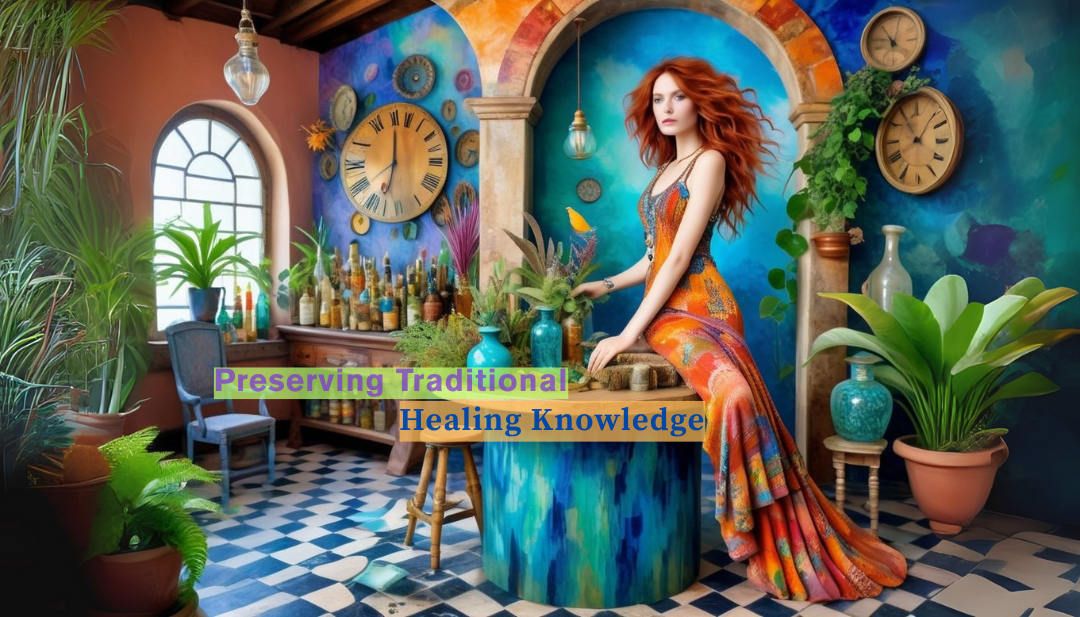
Preserving Traditional Healing Knowledge
Preserving Traditional Healing Knowledge
From big cities to quiet rural towns, knowledge about local healers travels by word of mouth, trusted recommendations, and the kind of knowing looks that say, “You should talk to them.” These community healers aren’t celebrities or highly credentialed specialists. They’re everyday people who carry forward time-honored ways of caring for others, often passed down from older generations.
Traditional medicine isn’t a single remedy or one-size-fits-all approach. It’s a collection of practices shaped over centuries, each adapted to local needs, plants, and beliefs. One healer might be known for treating burns with plant poultices, while another specializes in easing back pain or calming anxiety with herbs. Unlike the clinical feel of a hospital, these practices are personal. The healer knows you, your family, and your personal history, creating a trust built through years of shared experience. That trust is often as important as the treatment itself.
When modern treatments come up short, many turn to these older ways. It’s not about rejecting science, but about recognizing that health is complicated. Sometimes you want more than a prescription slip. You want to sit with someone who listens carefully, who mixes herbs by hand, who explains their uses in a way that connects you to generations of knowledge. It’s about treating the whole person—body, mind, and spirit—rather than just chasing symptoms and curing one thing while creating a dis-ease (disease) somewhere else.
Folk healing traditions vary tremendously, but they share certain qualities. They’re local and grounded in a community’s experience with its environment. And they often rely on simple materials, a leaf, a root, a whispered phrase, the laying on of hands. The power lies not just in the plants themselves but in how they’re prepared, shared, and used. Many of these practices have developed elaborate steps that people believe are essential to success. For example, someone treating warts might use a common vegetable such as a potato, but follow specific steps about how to bury it in the ground.
These methods can sound old-fashioned, even quaint, in our modern world of lab-tested drugs and high-tech diagnostics. But they endure for a reason. Over generations, communities have observed, tested, and refined what works for them. These healers aren’t quacks hawking miracle cures for profit. In fact, many refuse to charge a set fee at all, relying on small gifts, a love offering, or favors given in gratitude. The focus is on helping, not selling.
Passing on this knowledge is treated as a responsibility. Often, a grandparent or elder chooses someone in the family who shows interest or care to receive it. It’s not the sort of thing you pick up from a single class or a how-to book. It requires time, practice, and a real commitment to helping others. Healers learn not only recipes and techniques but when to use them and when to say, “This is beyond me,” and suggest seeing a modern doctor.
This coexistence with modern medicine is important. While some health professionals dismiss folk practices as outdated, others see their value. In many places, doctors understand that these traditions provide real comfort and can even work alongside standard treatments. There are stories of medical providers quietly encouraging patients to try traditional methods when nothing else seems to help. They know that hope, reassurance, and cultural connection can be powerful allies in the healing process. While there is no medical backing showing how a potato can get rid of warts, perhaps it was done once and during this period of “treatment”, the wart went away on its own, thus giving birth to this age-old cure. Much like washing a car and then having it rain later in the day, the first action doesn’t result in the second action, but we still find comfort in this ancient knowledge and maybe… just maybe…
Scientific research is beginning to catch up with what these communities have known for generations. Take turmeric, for example. Long used in traditional healing for its anti-inflammatory properties, studies now support its role in managing arthritis and other inflammatory conditions. Ginger, ashwagandha, valerian root, and elderberry all have growing evidence bases as well. Many people today choose these herbs in standardized supplement form, seeking reliable dosages while honoring their origins in traditional knowledge. Discover more about these cures, hiding in plain sight.
Personalized wellness is another reason these older practices are thriving. With the rise of DNA testing, gut microbiome analysis, and wearable health tech, people want routines that fit their unique needs. Herbal supplements and folk remedies are a natural match for this trend. Someone might choose valerian root for sleep while another person uses it for muscle tension. Others pick adaptogens like ashwagandha to manage stress or boost focus. This flexibility makes herbal medicine especially appealing in a world that increasingly values customized care over mass-produced solutions.
Interest in herbal medicine isn’t just about personal health, either. It’s tied to bigger questions about sustainability and ethics. Consumers are more aware of where their products come from and how they’re sourced. They want companies to treat local communities fairly and protect ecosystems that provide these valuable plants. For many, buying herbal products is also a statement about caring for the planet, supporting traditional cultures, and rejecting over-commercialized healthcare systems that often feel impersonal and profit-driven.
Healers also care for animals in many traditional settings. In farming regions, local healers might treat a cow with mastitis or help a horse recover from colic using plant-based solutions. These animal remedies show that folk knowledge is not just about human health but about maintaining balance in the entire environment—people, animals, and land co-existing together.
Of course, these traditional healing systems face serious challenges in the modern era. As urbanization spreads and lifestyles grow increasingly hurried and disconnected from the land, the once-intimate chain of knowledge transfer from elder to youth grows fragile. In many communities, younger generations leave for cities in search of work, education, and convenience, carrying away their potential to inherit and continue these time-honored practices. The knowledge risks being lost forever, not because it has no value, but because there is no one left to receive it.
When we allow such traditions to vanish, we risk narrowing our approach to health and healing into something mechanistic and transactional. Without these alternative perspectives, modern society may become even more dependent on pills and procedures as the only sanctioned solutions to human suffering. This is not to deny the tremendous value of biomedicine, but to acknowledge its limits. A system that sees health purely as the elimination of symptoms can overlook deeper needs: balance, connection, context, and meaning.
Losing traditional healing knowledge means losing not just recipes and remedies but entire philosophies about living in alignment with nature. It means forgetting the seasonal rhythms of harvest and preparation, the community networks of care and reciprocity, the respect for the plants and ecosystems that sustain us. It is an erosion of cultural memory that leaves people more vulnerable to the alienation of consumer culture, where health is just another product sold in sterile packaging.
Yet there is also a powerful countercurrent. Many younger people are actively seeking to reconnect with ancestral knowledge before it slips away entirely. They are asking questions, sitting at the feet of elders, recording stories and techniques, and refusing to let centuries of experience disappear into silence. For some, this effort is an act of cultural preservation, a way to honor lineage and maintain identity in an increasingly homogenized world. For others, it is a conscious choice to embrace a more holistic, compassionate, and sustainable approach to health, one that values prevention, lifestyle, and respect for the body’s own wisdom alongside clinical intervention.
This renewal is not about clinging to the past out of sentimentality. It is about addressing the blind spots of modern healthcare, which, for all its breakthroughs, many times fails to see the whole person. It is about offering a more complete vision of wellness that respects not just the science of disease but the art of living well. Traditional practices remind us that healing is not simply about killing germs or repairing broken parts; it is about cultivating right relationship with our bodies, our communities, and even our environments.
Traditional healing is not some relic sealed away in history books. It is very much alive. It lives in the city herbalist blending tinctures for stress and sleep. It thrives in the worn hands of grandparents preparing poultices in warm kitchens. It has found new life on the shelves of health-food stores, where apoptogenic teas and immune-boosting syrups sit beside modern supplements. Alternative healing is emerging with the training of certified herbalists and naturopathic practitioners who weave traditional plant knowledge with contemporary clinical understanding.
Imagine healthcare that respects cultural diversity, that acknowledges traditional healers as allies, and takes the time to empower patients with real choices beyond a prescription pad. Imagine a society where respect for the land that provides our medicines becomes part of our ethical obligation, reminding us that fostering sustainability outweighs exploitation.
By safeguarding these traditional healing practices, we do more than preserve quaint family traditions and customs. We keep alive entire worldviews that challenge the reduction of health to chemical formulas alone. We protect languages, stories, and rituals that have guided human beings through illness and uncertainty for generations. We sustain an approach to wellness that is deeply human, one that sees health not as the absence of disease but as the presence of balance, purpose, and connection.
In this moment we are now offered a choice. We can allow traditional healing knowledge to fade quietly into oblivion, another casualty of progress, or we can recognize its value and make space for it to evolve alongside modern medicine. By doing so, we honor our ancestors, enrich our cultural landscapes, and offer ourselves and future generations more ways to be well.
Let me hear from you! What holistic or ancestral remedies have been shared in your family? What traditions have helped you or someone you know find relief, comfort, or connection? Leave a comment below and share your story. Let’s keep this conversation going and honor the knowledge that has been passed down through generations. Who knows? Your experience might inspire someone else to rediscover their own path to wellness.