
Spiritual Meaning of a Broken Clock: An Intuitive Awakening Story The clock on the living room wall had been part of the room for so many years that I rarely gave it any attention, yet on that particular afternoon its silence felt impossible to ignore. Sunlight gathered along the far counter in a wide band of gold, warming the worn surface of the table and catching faint particles of dust that drifted slowly through the still air, and in the middle of that quiet brightness the unmoving hands of the clock seemed to hold the entire room in suspension. The spiritual meaning of a broken clock did not reveal itself all at once, but began in a moment of stillness I almost ignored. I stood there longer than necessary, my hot chocolate cooling in my hands, aware of a feeling that did not yet have language but carried a very unmistakable weight of change. Life during that year had narrowed into what I felt was an obligation. Each day unfolded according to schedules, molded by responsibility rather than desire, and the future felt less like an open landscape than a distant promise that was always broken. I measured progress by how much I could carry without asking for rest. Many people who experience strong intuition learn this pattern early, sensing truths beneath the surface of daily life while convincing themselves that survival must come first. The broken clock interrupted that rhythm without making a sound. Time, which had always pressed forward and uncontrolled like the White Rabbit, now appeared paused in plain sight. The stillness of the room created a question I could not easily dismiss. If motion stopped for even a moment, what truth might finally become visible? Days passed, and I chose not to repair it. Something within me needed that solid stability. I needed proof that life would not collapse if I stopped rushing toward the next thing on my To Do List. Each time I walked through the living room, the stopped clock reflected a deeper awareness that was forming. It was an awareness shaped by exhaustion, unanswered longing, and the growing realization that I had been living according to expectation rather than my own inner guidance. I later understood that the spiritual meaning of a broken clock was never about time itself, but about the life I had stopped living. I began to see how often fear had shaped my decisions, how frequently I had protected stability at the cost of authenticity, and how many dreams had been set aside in the name of responsibility. None of these truths appeared dramatic from the outside, yet together they revealed a life moving further from alignment with each passing year. The Moment Everything Became Clear This is where the spiritual message of a broken clock begins to unfold. Stillness creates space for honesty, too few are brave enough to actually stop and listen, stop and watch. What appears inconvenient may in fact be necessary, especially for those who sense meaning through timing, symbols, and emotional undercurrents that others blindly overlook. Spiritual Meaning of a Broken Clock Transformation rarely begins with certainty, that’s for sure. It begins with discomfort strong enough that we have to stop and say, what the hell is going on? It gets our full attention. I did not wake one morning filled with courage or clarity. Change entered through smaller choices that felt almost insignificant at the time. One conversation spoken with honesty instead of avoidance. One boundary expressed without apology. One evening of rest chosen over exhaustion. Each decision shifted something subtle yet undeniable, and over time those shifts created movement where stagnation once lived. Once I recognized the spiritual meaning of a broken clock, the pause I feared became the beginning of change. Learning to Live Differently Listening to intuition required patience. For years I had dismissed inner knowing in favor of practicality, believing logic offered greater safety than feeling. Allowing that inner voice to guide even minor choices felt unfamiliar, yet the results carried a steadiness I had not experienced before. Energy returned gradually, my confusion softened, and before I realized it, a new direction emerged. The day finally came to remove the broken clock from the wall. That silent object had marked the threshold between endurance and awareness. The face of the clock had been staring me in my own face, holding a place for a pause I had been unwilling to claim for myself. The new clock that replaced it ticked with ordinary precision, yet the sound felt different. Time itself had changed its relationship to my life. Anyone searching for the spiritual meaning of a broken clock is often searching for something deeper than symbolism. A stopped clock asks what in life has frozen, what truth has been delayed, and what inner guidance has gone unheard beneath the noise of obligation. These questions rarely appear for your comfort, yet they often signal the beginning of realignment. Many intuitive awakening stories begin in disruption rather than inspiration. Loss, fatigue, endings, or unexplained stillness create openings that ordinary busyness once concealed. Within those openings, awareness strengthens and direction becomes visible in ways effort alone could never produce. If you find yourself living inside a season that feels paused or uncertain, consider the possibility that this stillness is carrying a message for you. External movement sometimes slows so internal clarity can emerge. Endings occasionally arrive to create space for a different future. Awakening often feels like confusion before it reveals itself as peace. The deeper message carried by the broken clock speaks with simple honesty. Awareness without action leads to continued suffering. Intuition ignored leads to exhaustion that no amount of effort can repair. Alignment restores clarity, energy, and direction in ways that feel both grounded and true. When you stop to think, the message has always been there. Following the signs, walking a new path, often turns into the past of least resistance and life again returns to a
Be the Change: A Journey of Inner Transformation
Be the Change: A Journey of Inner Transformation When I first heard Mahatma Gandhi’s words, “You must be the change you wish to see in the world,” something deep within stirred. For years, I searched everywhere for answers, attending workshops and reading books about spiritual growth. Yet true transformation waited until I understood how to be the change within myself first. That crisp autumn morning on the quiet trail, I finally heard the message clearly. Peace had never left me. I simply needed to be the change by turning inward instead of outward. As leaves crunched beneath my feet, I felt connected to a larger energy that whispered one truth: real power begins when we choose to be the change in our own hearts. As the years went by, life proved to be an unexpected teacher. I had spent so much time seeking purpose through other people’s opinions that I forgot how to listen to my own inner voice. I read countless books on spiritual growth and metaphysical principles, hoping that one of them would tell me who I was supposed to be. But instead of feeling enlightened, I felt lost in a sea of other people’s wisdom. My heart longed for clarity that could not be found in words alone. Everything changed one morning when I decided to leave my phone at home and walk the nature trail near the lake. The air was crisp and quiet, and for the first time in months, I could actually hear the rhythm of my own breathing. As I walked, I realized that peace had been waiting for me all along. It had never disappeared. I had just stopped paying attention to it. That morning, I didn’t feel small or insignificant. I felt connected to something vast and living, almost as if the earth itself had whispered, “Start here. Start with you.” The Mirror Within I used to think the purpose of relationships was to complete me. I saw each friend and partner as a piece of a puzzle that would someday make me whole. But my understanding changed. I began to see that every person I met reflected something within myself. Some encounters brought joy and inspiration. Others tested my patience and revealed old wounds. Over time, I realized that the people who stirred discomfort were my greatest teachers. They showed me parts of myself I wanted to ignore. Whenever someone frustrated me, I asked, “What is this trying to show me?” That simple question opened the doorway to healing. It taught me responsibility for my reactions and emotions. Forgiveness followed. Not once, but daily. I stopped demanding apologies from others and started forgiving myself for not knowing better sooner. As I released the need to control outcomes, my energy shifted. I did not have to change the world around me because the change had already begun inside. The Flow of Energy My journey led me into deeper study of energy and how it shapes emotion, health, and thought. During meditation, I began using visualization exercises I had once doubted. I imagined light filling my body and surrounding me with calm. At first, it felt more like a creative exercise than any sort of transformation. But over time, it became real. The energy felt alive, warm, and supportive. Instead of reacting when tension or fear appeared, I learned to sit still and breathe through it. The energy within me started to feel balanced and focused. Each small act of awareness became a turning point. I discovered that change does not happen all at once. It builds quietly through repeated choices toward peace, understanding, and compassion. Synchronicities began to appear. I might think of an old friend and receive a message from them within hours. I might ask for guidance and find a feather on my path or a song that spoke directly to my current situation. These moments reminded me that life responds to our vibration. The more I aligned with love, the more love appeared in my experience. The Ripple Effect With time, others began to notice. A colleague mentioned that I seemed calmer in stressful situations. A family member said it felt comforting to be around me. I was not trying to influence anyone, yet something deeper had shifted. My internal state was inspiring others to reflect on their own. It dawned on me that transformation spreads like water rippling outward. When one person chooses awareness and compassion, that energy travels through every connection they touch. Each act of grace creates another, and this chain reaction begins to reshape the larger world. Lessons Along the Way When I looked back on what transformation had taught me, three core truths stood out clearly. These insights changed everything about how I viewed life. I no longer waited for someone to rescue me or for circumstances to improve. I understood that by embodying the version of myself I hoped to see in the world, I was already creating the change I sought. Living the Practice Transformation did not require grand actions. It found me in quiet choices—speaking with kindness instead of irritation, choosing gratitude instead of complaint, pausing to breathe before reacting in anger. Each small decision became a prayer in motion. I began every morning by whispering words of thanks. Even during difficulty, I found something to appreciate—a sunrise, my breath, the sound of rain. I wrote affirmations on slips of paper and kept them on my mirror: “I am calm”, “I am open”, “I am love.” Over time, those statements rewired the way I thought, helping me meet life from a place of strength rather than fear. What surprised me most was how challenges transformed too. Problems no longer felt like punishments but opportunities to evolve. When obstacles appeared, I asked a new question: “What is this moment trying to build within me?” That single question turned setbacks into steppingstones and pain into understanding. A New Kind of Change Now, looking back, I see how Gandhi’s words carried a timeless truth. Real transformation begins inside, not outside.

When Nights Grow Longer
When Nights Grow Longer October kicks off under the Sun in Libra, and the theme of balance is already in the spotlight. After September’s eclipses rattled the collective mood, the new month brings a different rhythm. Libra season is not about swinging wildly to one side or the other. It is about finding the sweet spot between extremes, even if it takes a little wobbling to get there. Think of it less like perfect equilibrium on a scale and more like learning how to stand on a paddleboard without falling in. By all means, this is not a month that encourages autopilot. Each planetary movement adds another layer, calling attention to what we have ignored, avoided, or simply postponed. October holds up a mirror and dares us to look, truthfully. Fire Meets Reflection On October 6, the Full Moon in Aries blazes onto the scene. Full Moons are dramatic by nature, and Aries rarely enters quietly. This moon highlights independence, courage, and self-assertion. Yet with the Libra Sun across the sky, it is not enough to charge ahead with personal goals. The bigger question becomes: how do my choices affect the people closest to me? If you have been biting your tongue to keep the peace, this Full Moon may end your silence. If you have built walls in the name of independence, it may point out just how lonely those walls feel. The Aries–Libra push and pull shows that one side cannot thrive without the other. Independence without intimacy becomes hollow, and intimacy without individuality quickly becomes heavy. Expect themes of leadership, vitality, and new beginnings to show up. Just remember that this is not about abandoning what you have built. It is about striking a healthier balance, even if it means saying no to what no longer fits. Shadows Take Shape October 13 turns the dial up a notch as Pluto ends its retrograde and shifts forward. When Pluto changes direction, it rarely feels subtle. Months of inner digging and shadow work now want to spill into the outside world. Power dynamics, hidden truths, and simmering frustrations may demand action. Luckily, Venus also enters Libra on the same day, which softens the mood. Relationships may feel both intense and sweeter at the same time, which is a strange combination but a useful one. Pluto insists on honesty, while Venus prefers harmony. Together, they create a window where tough conversations can be had without everything turning into a soap opera. That said, suppressed emotions could still surface like geysers. If that happens, better to deal with them than try to shove them back down. A New Balance October 21 brings the Libra New Moon, an opening for new beginnings in relationships, cooperation, and fairness. Libra’s energy wants things to feel balanced and beautiful, but squares to Jupiter and Pluto make sure we do not overdo it. Lofty promises or overblown expectations could easily fall flat. Keep goals realistic, and progress will feel more lasting. It is worth noting that Mercury enters its pre-retrograde shadow the same day. Themes and conversations sparked now will circle back in November. If something feels familiar or like it refuses to resolve, consider it a preview of what Mercury retrograde will revisit. Dreams Return Again On October 22, Neptune drifts back into Pisces for one last stay before it leaves for good in 2026. Neptune in Pisces heightens sensitivity, spirituality, and imagination, but it also blurs lines. This return may feel like unfinished business. This could manifest as: Also on this day, the Sun enters Scorpio, which shifts the tone dramatically. Libra’s grace gives way to Scorpio’s depth. The season becomes less about smoothing things over and more about facing the truth head-on. Scorpio energy is about transformation, and it does not mind getting messy in the process. If Libra set the table, Scorpio asks what is really being served.You will need to ask yourself, is it cold like guacamole or hot like home-made soup? Beliefs Under Pressure On October 23, Jupiter locks into a square with Chiron, the first of three such alignments in the months ahead. This influence can feel like pressure on your core beliefs. Assumptions once taken for granted may wobble, and convictions may not hold up under scrutiny. Some may feel isolated, as if no one else understands their perspective. Ever had a time like that? While uncomfortable, this is not wasted energy. Cracks in your philosophy expose what was borrowed, outdated, or flimsy. What remains is what truly belongs to you. The square between Jupiter’s optimism and Chiron’s wounded healer archetype creates a strange but useful tension. It is hard to cling to illusions when reality keeps poking holes in them. So What Does This Mean October 2025 is a month that refuses to stay shallow. Every shift points to balance, but not the tidy version with everything perfectly aligned. Balance here means movement, like walking a tightrope or keeping a bike upright. Wobbles are part of the process. The Aries Full Moon highlights the tug between independence and intimacy. Pluto moving direct pushes us to act on what has been bubbling under the surface, while Venus in Libra reminds us not to bulldoze relationships in the process. The Libra New Moon offers a fresh start, but grounded intentions beat grand declarations. Neptune’s return to Pisces reopens the door to spiritual and creative insight, while the Sun in Scorpio asks us to go deeper than surface-level harmony. Finally, Jupiter square Chiron tests our beliefs, but what survives the test will be sturdier than before. October is not about perfection. We are recalibrating. It’s time to refocus on the North Star, get our bearings, and move forward. The month teaches us that balance is a living process, not a final destination. Growth comes from holding opposites without dropping either one. Reflections for the Journey Which themes feel the strongest for you this October? Maybe it is the tug-of-war between self and partnership. Maybe it is the shifting beliefs

Goldenseal and Medication Interactions: What Every Herbal Enthusiast Should Know
Goldenseal and Medication Interactions: What Every Herbal Enthusiast Should Know Goldenseal (Hydrastis canadensis) has a long history as a North American medicinal herb, prized for its bright yellow rhizome and powerful antimicrobial properties. Traditionally used for digestive issues, infections, and as an immune tonic, goldenseal remains a popular ingredient in modern herbal formulas. But there’s more to this herb than meets the eye—and not all of it is harmless. How Goldenseal Affects the Body The secret to goldenseal’s potency lies in its isoquinoline alkaloids, particularly berberine and hydrastine. These compounds give the plant its antimicrobial and anti-inflammatory effects—but they also interact with the very enzymes and transporters that help your body process medications. Scientific studies show that goldenseal inhibits CYP3A, a key liver enzyme that metabolizes nearly half of all prescription drugs, and also interferes with P-glycoprotein (P-gp), a protein that pumps drugs out of cells . This dual action means goldenseal can dramatically raise blood levels of certain medications. Medications at Highest Risk If you take any of these drugs, adding goldenseal could lead to dangerously high concentrations in your system: Immunosuppressants (tacrolimus, cyclosporine, sirolimus) – risk of kidney or neurological toxicity Blood thinners (apixaban, rivaroxaban) – increased bleeding risk Heart medications (digoxin, certain calcium channel blockers) – potential arrhythmias or severe low blood pressure Sedatives (midazolam, alprazolam) – excessive sedation or breathing problems Statins (simvastatin, atorvastatin) – higher risk of muscle damage or rhabdomyolysis Certain cancer therapies and corticosteroids – unpredictable and potentially dangerous effects Because even small changes in blood levels can cause serious side effects, many practitioners recommend avoiding goldenseal entirely if you’re taking any of these medications. Why Standardization Matters To make things more complicated, goldenseal supplements vary widely in alkaloid content depending on how they’re grown, harvested, and processed. Without standardized dosing, predicting the strength of interactions becomes nearly impossible. Until clearer guidelines exist, it’s safest to assume that any goldenseal preparation can have strong drug interactions. Key Takeaway Herbal remedies can be powerful allies, but “natural” doesn’t always mean “risk-free.” Always talk to your healthcare provider before adding goldenseal—especially if you take prescription medications. A quick conversation can prevent serious complications and help you use herbs safely.
Physiology and Holistic Strategies to Enhance It
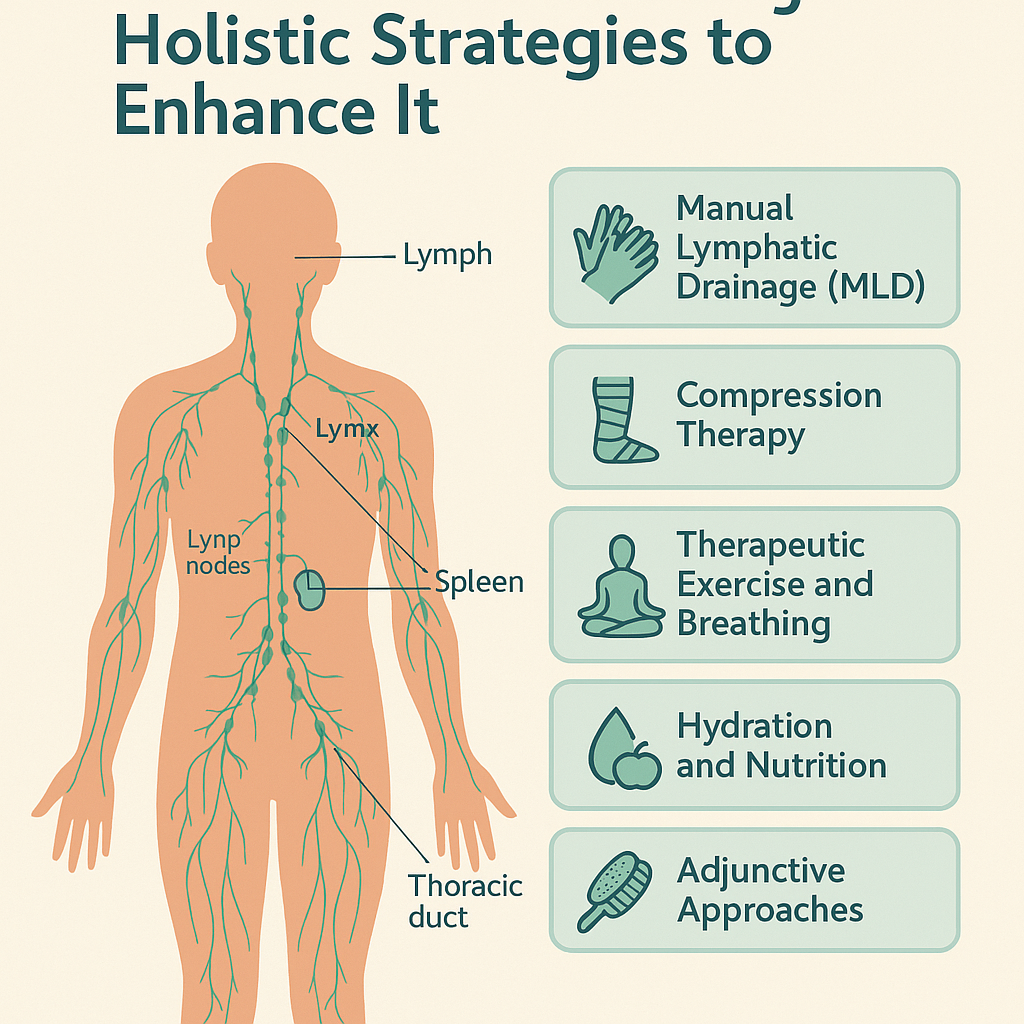
Physiology and Holistic Strategies to Enhance It The lymphatic system is a low-pressure, open circulatory network that performs three vital tasks:returning interstitial fluid and proteins to the bloodstream,transporting absorbed dietary lipids, and supporting immune surveillance by carrying antigens and immune cells to lymph nodes (Ozdowski & Gupta, 2023; Welsh & Prentice-Carver, 2023).Although it parallels the vascular system, the lymphatic system lacks a central pump, making it uniquely sensitive to stagnation and obstruction. How Lymph Flow Is Generated and Maintained Lymph formation begins in blind-ended lymphatic capillaries. Overlapping endothelial “button-junctions” allow interstitial fluid to enter whenever outside pressure exceeds the pressure inside the vessel. From there, lymph moves into collecting vessels equipped with one-way valves and smooth muscle layers that rhythmically contract to propel fluid forward (Ozdowski & Gupta, 2023).These intrinsic vessel contractions are the primary drivers of lymph propulsion, while extrinsic forces—skeletal muscle movement, respiratory pressure changes, and arterial pulsations—add further momentum (Barnhart, 2024; Welsh & Prentice-Carver, 2023).Ultimately, lymph passes through lymph nodes for immune surveillance, drains into larger trunks and ducts, and empties into the venous circulation at the junction of the subclavian and internal jugular veins (Welsh & Prentice-Carver, 2023). Because there is no heart-like pump, inflammation or obstruction can quickly slow or halt this delicate flow (Ozdowski & Gupta, 2023). Holistic Protocols to Enhance Lymph Flow A variety of integrative approaches can help keep lymph moving efficiently. These strategies are gentle yet powerful when applied correctly. 1. Manual Lymphatic Drainage (MLD).Light, rhythmic strokes and stretches of superficial tissues encourage lymph movement and reduce interstitial pressure. MLD often provides short-term relief, but outcomes improve when it is combined with compression, exercise, and skin care as part of Complete Decongestive Therapy (Vairo et al., 2009). 2. Compression Therapy.Bandages, garments, or intermittent pneumatic compression devices provide external pressure that assists venous and lymph return. Compression works best when paired with manual techniques (Remien et al., 2024). 3. Therapeutic Exercise and Breathing.Gentle aerobic activity activates the skeletal-muscle pump, while diaphragmatic breathing enhances intrathoracic pressure changes that “suction” lymph centrally—mechanisms described in standard physiology texts (Welsh & Prentice-Carver, 2023). 4. Hydration and Nutrition.Adequate hydration reduces interstitial viscosity. Anti-inflammatory nutrition rich in antioxidants and omega-3 fatty acids supports vessel function. Herbal supports such as Galium aparine (cleavers) are sometimes included in clinical herbalism, though evidence remains limited. 5. Adjunctive Approaches.Dry brushing, contrast hydrotherapy, gentle yoga, or rebounding are frequently used in wellness settings. While evidence varies, these methods can complement primary protocols when practiced with care. Contraindications, Precautions, and Stress Considerations Even natural therapies require thoughtful screening. Avoid lymphatic techniques in the presence of:Acute infection or systemic illness (e.g., cellulitis, sepsis), which may spread pathogens (Remien et al., 2024).Congestive heart failure, where fluid mobilization can overload cardiac function (Welsh & Prentice-Carver, 2023).Deep vein thrombosis, due to the risk of clot dislodgement (Remien et al., 2024).Severe renal/hepatic insufficiency or uncontrolled hypertension, where fluid shifts may worsen disease.Active malignancy, where MLD is generally considered safe but should only be performed with oncologist guidance (Godette et al., 2006).Acute fractures, bleeding, or severe local inflammation, until cleared by a healthcare professional.Practitioners should use minimal pressure, monitor patient tolerance, and progress gradually, particularly in frail or highly stressed individuals. Too much force can collapse the delicate lymphatic vessels (Barnhart, 2024). Key TakeawayThe lymphatic system safeguards fluid balance and immune transport, but its lack of a central pump makes it vulnerable to stasis. Integrative strategies—manual drainage, compression, therapeutic movement, breathing practices, and supportive self-care—can significantly improve lymph flow when applied carefully. Respecting contraindications ensures these methods remain safe and effective, enhancing tissue health, supporting immunity, and contributing to overall wellness.
The Beauty of Being Lost
The Beauty of Being Lost To be lost, in the way I experienced it, was not the kind of thing solved with a map or a GPS reroute but a deeper unraveling, one that ripped away and slowly dissolved the edges of who I thought I was until I felt like a guest in my own life. My job, that had once seemed respectable, and the routines that had once felt solid now were brittle scaffolding barely holding me upright. From the outside everything appeared orderly and dependable, yet the inside told another story entirely, a story of misalignment and drift, a story where my own voice had grown faint under the weight of obligation and habit. The realization did not appear with fireworks or any sort of fanfare like they do in the movies. There was no dramatic soundtrack to my life. Hardly. It snuck in during the ordinary days when I noticed how little of myself was left in the roles I played. There was a weird comfort in being efficient and admired. I’m not a role model, I’m not sure why they looked to me. But beneath the surface there was also a growing recognition that the puzzle I had built so carefully did not resemble the life I wanted to live. That was terrifying, but it was also the beginning of a different kind of navigation. One built on honesty. The Silence After the Noise Disorientation came quietly, sneaking up on you like a thief in the night. There were mornings when the thought of walking into the building left me stalled in the car, staring at the glass doors as though they belonged to someone else’s reality. I felt like I was on another timeline. Explanations like “fatigue” or “stress” were easy to offer, yet they were only masks for something more difficult to admit. The life that once fit no longer did, and I had no replacement ready. Spiritual lostness often disguises itself as boredom or weariness, but underneath lies the unsettling sense that what once nourished has gone flat. Music, books, conversations, even the daily rituals that had once soothed me, all of them began to feel strangely hollow. I felt as though my participation had become meaningless and detached. The very habits that had carried me began to restrain me, and the structures that once felt safe began to press against me like walls closing in. All I could think of, all day long, was how to escape this prison I put myself in. How did I get here and more importantly, how do I get out. I was in it for the long game. Instead of surrendering to that awareness, more effort was piled on in the hope that motion could mimic meaning. Extra projects, endless lists, late nights at the studio. All of it became an attempt to outrun the quiet voice asking if I was still on my true path. Who guides the lost lightworker when they have no light to shine, no path to follow? That strategy failed in the way all strategies do, with the body shouting out what the mind refuses to acknowledge. Migraines that felt like rusted railroad spikes hammered into my head, stretching across my skull, stiffness anchored in my spine, and my chest carried a weight that seemed to squeeze harder each week until the truth could no longer be ignored. Something in me was begging for change. When Life Feels Misaligned The unraveling of life hit me in the face one morning. My car gave out on the side of the road. As vehicles rushed past, leaving me alone with the smell of oil and the unfamiliar quiet, the strangest sense of relief washed over me. I closed my eyes and saw myself standing in the surf, the only movement was the sand shifting beneath my feet. In that moment, there were no urgent meetings, no task list could demand anything of me. For the first time in months, perhaps years, there was nothing to do but sit in stillness. That enforced pause allowed an admission I had been resisting. Lostness was not a failure of will or discipline. Lostness was the truth. Far from the disaster I had feared, confessing it felt like loosening a knot that had been cutting off circulation. What I had previously seen as a weakness of character became a doorway into something not yet named, but waiting for me nonetheless. Listening for Soul Nudges In the space created by my “surrender to the Universe” and a car mechanic, small signals began to make themselves known. I called them Soul Nudges. A friend mentioned a retreat I had quietly looked into months before, but dismissed as impractical, I don’t have the time, it’ll cost too much… But this time, the invitation landed with a power I could no longer ignore. The synchronicities began. A book slipped from a shelf in a store, landing open on a page that carried words so piercingly apt they seemed written for me. Memories of childhood joys, long buried under hours of work and “have-to-dos” resurfaced and made me pause. And then I saw it, the nudge that made me really believe… the yellow butterfly. These experiences were not “up and in your face” events. They were so subtle, almost imperceivable, yet in the quiet of chaos they carried more power than any formal direction could. Each “nudge” reminded me that meaning does not disappear, it waits patiently until we have cleared enough noise from our life, from our mind, to recognize it. The more I noticed, the more I understood that guidance often appears cloaked as coincidence, and that the very state of being lost has created the room and prepares us to notice what we might otherwise dismiss. From Lost to Found Writing each day became my thread through the fog. At first, the journals filled with confusion and contradiction, tears from trauma, but over time recurring words surfaced,
The Day Grief Moved Out
The Day Grief Moved Out I lost my father in 2021, though the real departure happened decades earlier, when I was eight years old and still learning to tie my shoes without thinking too hard about it. He left without a scene, without noise, and without explanation. There was no phone call, no clumsy adult attempt at comfort or closure. He was just gone, half the closet empty. The hangers were still rocking back and forth, he left so quickly. In the vacuum he left behind, I cried and tried to rationalize what happened. I didn’t realize it at the time, but those actions became the scaffolding for every silent rejection I absorbed later. Not good enough. Not worth staying for. Not lovable enough to anchor a father’s presence. I didn’t even realize that I was thinking those things; they were just woven into my soul. And eventually, they were buried. I grew up and life went on, but I didn’t know I was still carrying that pain, it wasn’t really in my memory. Oddly enough, I carried it in the joints of my body and in the breath that I never let it deepen. It was festering there, showing up in my need to keep over-achieving, pleasing, and always pushing forward. Looking back I realize I did everything I could possibly do, as long as it didn’t require me to stand still long enough to feel what had not finished moving through. I did the work, or so I told myself. I read the books, and journaled about my childhood. I learned about shadow work and while working through that, I learned about self-worth. Finally, after many years, I healed and began to feel good about myself. But the body knew what I didn’t–pain has a way of remembering for you. In the weeks leading up to the anniversary of my father’s death, I began noticing strange synchronicities. A stranger with his posture walked past me, sucking out the breath in my body. I had to do a double take. A song he once hummed, no longer popular, came on the radio. A phrase he used to say, repeated by someone who couldn’t possibly have known. They were the triggers, bring forward memories I had locked away. When the last anniversary of his death rolled around, I took a honest look at my life and realized I was totally alone. My husband died shortly after we married and now my bio-family was gone too. Dealing with so much loss over the years, I was too consumed with grief and trauma and I never noticed my physical state deteriorating. My body and mobility had changed completely and I never saw it until it was too late. I didn’t just ache because I was “getting older”. I wasn’t “just stiff and sore”. I was in severe pain and physically limited… and alone. Walking was almost impossible. Steps became a conscious act, like counting coins you cannot afford to spend. Still, I kept showing up daily to life with a smile on my face, but beneath it all, something stayed locked, literally. My back, my hips, my breath. Everything had tightened into protection, searching for safety and security. I realized my body had become a jail and someone had thrown away the key and I was desperate to escape from it. On the hardest day, the day that marked his leaving of this Earth, I forced myself to get up out of bed. I had lost my job weeks earlier, lost my family, and I was on the border of losing any reason for going on. But I am tenacious and I want to heal and live. I deserve happiness, even if I have to give it to myself (which turns out, is the only way you can ever find true happiness. It’s within yourself.). Wanting to heal, I struggled to get my legs to move, but I did, and I walked into a yoga class. I wasn’t looking for transformation. I knew that I was at the end and I didn’t want it to end like this; I was just desperate to hurt a little less. That day, my instructor noticed before I said anything. She kept her voice calm, her movements simple. When she saw me, I felt like I was pulling my body along, pulling an invisible rope and just trying to get into the room. I knew I looked like a fresh hell had emerged, with swollen, tear-filled eyes. I also knew that at any moment, I could let go of the rope and I would be fine. I was at that point. She came over, put her hands on my back and took away the cane I was using. At that point in life, it was the only support I had ever known. It was so much more than a physical crutch. Taking me to the back of the room and placing my hands on the barre, she helped me into a supported stretch. She didn’t use flowery words or spiritual maxims. She simply held space. When I twisted and began to go lower, something gave way. A pop in my back and hip cracked through the tightness like something had broken open. For a moment, I thought my bones had actually snapped. Then the crying began. Not surface-level tears, not the kind you wipe quickly and explain away. These were deep sobs that came from a part of me that had been holding grief like breath, just waiting my entire life for a safe enough place to let go. I didn’t cry like that at his funeral. I didn’t cry like that when I found out he had died. I cried like that because my body had been holding something for thirty years, and finally, it was allowed to be heard. It was the release I needed for my body to heal. The tears washed away some of the pain. I’m not quite there yet, but

Cursed by The Swingline Again
Cursed by The Swingline Again It began, as most spiritual crises do, with a stapler. Not just any stapler, mind you, but The Swingline I inherited from a past job and have kept ever since—not because it works well, but because I have unresolved abandonment issues tied to office supplies. There it sat, smug and slightly dusty, wedged between a dried-out glue stick, a half-used birthday candle shaped like a “4,” and a pen that only writes on receipts. I reached for it with hope. I pressed with intention. And, naturally, it jammed… again. In that moment, I did not just feel betrayed by plastic and springs, I felt spiritually blocked and energetically sabotaged. Metaphysically stapled to my own avoidance. Because nothing says “you still have work to do” like a broken Swingline reminding you that you have, in fact, shoved your shadow work into a drawer next to a Capri Sun straw and a single googly eye. The Junk Drawer It started innocently enough. A simple task, really. I needed to staple a few pages together—a to-do list, a grocery receipt, and a half-baked affirmation I scribbled on the back of a napkin: “I release all that no longer serves me.” It was a spiritual declaration, a new-leaf moment. I was ready. I had sage in one hand, my 17th attempt at life organization in the other. All I needed was the stapler. Cue Dramatic Music. Enter The Swingline, Stage Left. It was red once. Maybe. Now it’s the washed-out shade of regret. I found it half-buried in the drawer I never speak of. The Drawer–you know the one. The junk drawer. The cabinet of chaos. The energetic landfill where paperclips go to die and expired coupons, expiration dates long past, huddle together for warmth. I should have taken it as a sign when The Swingline refused to open without a minor exorcism. I jiggled it. I whispered to it. I offered it peace. Nothing. It jammed, as it always does, right when I needed it most. And in that jam, I felt it. The tension… the tightness… the karmic weight of years of avoidance wrapped in a twisted metal coil. Shades of Winifred Sanderson: I was cursed. Again. But of course, it is never just about the stapler. Metaphysically speaking, everything holds energy. Not in some vague, incense-laced, Pinterest-board kind of way—but in a tangible, residue-of-your-soul kind of way. That Swingline is not “just” a stapler, it is a symbol. A physical manifestation of unresolved energy, stored emotion, and spiritual procrastination. It is shadow work dressed as office equipment, living in your drawer like it pays rent. People think spiritual blockages show up as dramatic life events or lightning bolts of intuition. But more often than not, they show up in the little things—the broken zipper you refuse to fix, the to-do list that migrates from one notebook to another like a determined ghost, and yes, the cursed Swingline that keeps jamming because your subconscious is trying to tell you something. The universe does not always yell. Sometimes, it whispers in jammed staples. The Drawer from Another Dimension Everyone has one. Some people call it a utility drawer. Others call it the place where their dreams go to die. No one really opens it voluntarily. Me? That’s the one I hang the plastic trash back from. That should say a lot, right there. It is the drawer you crack open when you are looking for a pen but instead find old twist ties, two unmatched screws, a fortune cookie fortune that reads “You will soon be tired,” and enough dried-up pens to build a shrine to sadness and unfulfilled dreams. Energetically, it is where we store what we do not want to deal with. Emotionally, it is a vault of delay. Spiritually, it is a low-frequency time capsule, holding expired batteries, forgotten intentions, and buttons from shirts that were lost in 2009. And because energy loves to hide in the overlooked, this is where shadow work moves in, wears your old socks, and refuses to pay its half of the utility bill. I have come to believe that the more things you have in your drawer that you cannot identify, the more psychically static you are. Every unclaimed key is a question. Did I live there? Can I walk back into that house? Did they change the locks? Every half-melted crayon is a forgotten creative urge. Every bent paperclip is a reminder that you, too, have been twisted by circumstances and left in a place you did not ask to be. The Swingline, though—it takes it a step further. The Swingline does not just exist passively like the rest of the drawer detritus. It waits. It chooses its moment. It will staple one thing correctly and then jam for eternity, like a spiritual trickster daring you to examine your deeper resistance. The moment you try to get your life together—bam—it seizes up, as if to say, “Are you sure you’re ready to grow? Because your shadow says otherwise.” For the love of all that is sacred, when was the last time you tested your stapler? Be honest. Has it been months? Years? Did you inherit it from a co-worker who left unexpectedly in 2014? Is it a relic, a shrine piece, a totem of procrastination disguised as practicality? Because let us tell the truth here—if that stapler were a relationship, it would be the kind your best friend begged you to dump. It barely works, it constantly jams, and it has definitely made you cry at least once. Here’s the hard kicker: even though we know better, most of us will keep that broken stapler forever. Why? Because we think we might need it. We might one day want to staple something, and then we’ll have nothing. We will be left alone with our pages flying free, and our inner Virgo will riot. So we keep it, moving it from one junk drawer to the next. Maybe
From Caterpillar to Wings
From Caterpillar to Wings May is one of those in-between months that feels like a cosmic exhale. It is not quite the sleepy stillness of early spring, and not yet the full-sprint energy of summer. It is the warm cup of tea between what was and what is about to be. A beautiful, awkward bridge month where the air smells like honeysuckle and change, and everyone seems to be wondering if it is time to leap—or nap. This is the sweet spot. The season of almost. And nothing says “almost” better than the metaphor of the butterfly. Nature’s most glamorous late bloomer. Nobody rushes a butterfly. No one knocks on the chrysalis and says, “Hey, hurry up in there.” We all instinctively understand that transformation takes time. It is messy, silent, and sacred. And yet, when it is our own metamorphosis on the line, we start tapping our toes like the caterpillar is taking too long. Sound familiar? If life has felt a little upside down lately, take heart. You might not be stuck. You might just be in the cocoon. Welcome to the chrysalis phase, where everything old dissolves and everything new has not quite arrived yet. This is the pause before the pivot, and it is sneakily powerful—even when it feels like nothing is happening. It is the sacred stillness between chapters, where the old identity begins to unravel thread by thread, and the new one is not yet fully formed. To the outside world, it may look like inertia. But beneath the surface? A quiet storm of transformation is underway. Cells are rearranging, truths are being rewritten, and the soul is quietly negotiating its next leap forward. This is not stalling—it is sacred preparation. A necessary breath before the exhale. A hush before the symphony begins. There is a special brand of exhaustion that comes with being on the cusp of change. Fatigue rolls in not because you are lazy, but because your soul is preparing for a rewrite. You may find yourself confused, isolated, or overwhelmed by sudden bursts of clarity that fade just as quickly. You may be evaluating friendships, goals, wardrobes, hair colors—anything that no longer fits the person quietly unfolding inside of you. This is not chaos. This is the wisdom of rest. The cocoon stage is not for action—it is for sacred surrender. It is a gentle invitation to stop grasping, stop pushing, stop trying to control the outcome with spreadsheets and spiritual to-do lists. This is not the time to hustle your way to healing. It is permission, full and loving permission, to stop trying to force things into bloom and to instead honor the stillness that knows what it is doing. Rest is not wasted time. It is not laziness, nor is it weakness. It is deep, cellular preparation. It is the recalibration of your entire being before the breakthrough arrives. It is the moment in the movie when the main character looks out the window, music rising, before everything begins to change. And even though the audience cannot see it yet—something within them already has. The cocoon is where the old self quietly dissolves to make space for something truer. It is not glamorous. It is not efficient. But it is where the real magic happens. In the soft dark. In the quiet wait. In the pause so potent, it becomes the very foundation of your next flight. Transformation does not happen in the light. It begins in the dark, far away from the sight of the world and so very far away from applause. It starts when we allow the discomfort to do its job. Growth is not a spa day. It is more like emotional composting. Everything you thought was falling apart is, in truth, breaking open. So if it has felt heavy lately, take a breath. That pressure might be the exact energy needed to mold you into something new. The alchemy of becoming is not glamorous. It is crying at strange commercials. It is rewriting your plans on the back of a grocery receipt. It is waking up one morning with the sudden urge to start a podcast, change careers, plant tomatoes, or raise mini-goats. But then, something shifts. Suddenly, you notice you are not just thinking about change. You are feeling it. You catch yourself daydreaming. You pick up an old journal and write something bold in the margin. A new idea starts whispering to you at night, and it feels a little terrifying—but also wildly exciting. This is what it feels like to emerge. Emerging with wings is not a flawless process. Do not expect to soar straight away. Butterflies, even the most majestic ones, take a moment to dry off. You may stumble, just like a mini-goat. You may second-guess. But make no mistake—you are becoming. Every step, no matter how small, is sacred. As you step into this new chapter, be gentle with yourself. Let go of the idea that you must have it all figured out. You are allowed to evolve without explanation. You are allowed to shift your identity without holding a press conference. This version of you—the one guided by intuition and grounded in truth—is allowed to take up space. What feels expansive right now? What small, brave step is calling to you? Maybe it is signing up for that class on the care and feeding of mini-goats, or finally saying what you mean. Maybe it is deleting the app, the email, or the entire narrative you have been repeating for too long. Maybe it is releasing someone you thought was your friend. Whatever it is, follow it. Expansion rarely roars. It usually hums. To support this sacred shift, consider reaching for a few soul-nourishing tools. A sound bath, for example, can reset your nervous system like a lullaby for your cells. Solfeggio frequencies, especially those tuned to healing, are powerful allies when it comes to clearing old emotional debris. Music is not just entertainment—it is medicine.
Tending the Inner Garden
Tending the Inner Garden What Weeds in Your Life Need Pulling? May has arrived like an old friend carrying a basket of possibility and a bouquet of wildflowers. There is something about this month—the way it rolls in with more sunshine than sense, the way the air smells like second chances—that feels like an open door. The Earth is shaking off its sleep, stretching its limbs, and unfurling with quiet confidence. Everything seems to be reaching upward, eager to grow. And perhaps, deep down, so are we. For those who follow the stars—or who simply felt like the past two months steamrolled through their emotional landscape with all the grace of a runaway lawnmower—the recent eclipse season was no joke. There was a solar eclipse to wake us up, a lunar eclipse to wring us out, and enough inner upheaval to make even the most grounded person wonder if the cosmos was using us as a science experiment. But now, after the dust has settled and the sky has stitched itself back together, May steps forward with her hands on her hips and says, “Alright, darling. Now what are you going to do with all this space?” This, it turns out, is the perfect question. Because every soul, whether it is polished or slightly frayed, has a garden within. Some call it the spirit. Others refer to it as the emotional body, the subconscious, or the inner sanctum. But no matter what name you give it, it is there—living and breathing inside you, shaped by your experiences, your stories, and your dreams. And like any good garden, it needs tending. There are seasons when all we can do is survive. Weeds take root when no one is looking. They creep in through heartbreak, disappointment, fear, or the slow erosion of boundaries. They might disguise themselves as practicality or people-pleasing. They might look like overcommitment or that one friendship you keep out of guilt rather than joy. You know the one. Sometimes, they are not even weeds. They are plants that once served a purpose but have now outgrown their usefulness. Like that ivy of perfectionism—lush and determined, but choking out every breath of joy. May does not demand that you bulldoze your entire soul and start over. It asks you to take a good look at what is growing and decide—gently, lovingly, and perhaps with a little ruthlessness—what needs to stay and what has worn out its welcome. This is the month when we pull on our metaphorical gloves, grab the trowel of introspection, and poke around in the soil of our lives. It is messy work, to be sure. See those beautiful roses over there? Yeh, those. Look closer. That’s right, they protect themselves with razor sharp thorns. No one emerges from weeding unscathed. You will get dirt under your nails. You might uncover a few forgotten hurts buried beneath and discover why you are always busy and on the go. You might even find an old goal from 2017 still sprouting despite your best efforts to ignore it. The truth is, when it’s quiet around us and there is nowhere to go, nothing to do, we are left with only one option–to take a deep look and see who is lurking inside of us. But make no mistake—this is sacred work. Every time you name a pattern that no longer serves you, you make room for healing. Every time you say, “I deserve better than this,” you create space for grace. And every time you choose yourself—quietly, fiercely, without apology—you plant something beautiful. So, my darling, it’s time to shovel the… manure… and get the beds ready. The seed catalog just arrived and it’s time to plant. Of course, no one said this process would be tidy. Healing rarely is. You may find yourself crying over a cup of tea, laughing mid-meltdown, or talking to your houseplants like they are your spiritual advisors. This is all perfectly normal. In fact, it is encouraged. So where does one begin? Begin by noticing what has become overgrown. Are there parts of your life that feel cluttered, not just with stuff, but with obligations that no longer align with your heart? Are there thoughts you repeat to yourself like bad elevator music—subtle but maddening? Perhaps your weed is called self-doubt. Or maybe it answers to the name of comparison. It might show up as avoidance, procrastination, or that little voice in your head that sounds suspiciously like your high school gym teacher saying you will never measure up. That’s right–today is the day we climb that rope up to the top of the ceiling. Whatever it is, May invites you to name it. And then, slowly and steadily, begin the gentle process of letting it go. If you feel brave, grab a journal and write down the things you are ready to release. If you feel silly, talk to yourself out loud. Light a candle. Burn the list. Dance in your living room to a song that reminds you of who you were before the world told you who to be. This is your garden. There are no rules here, only rhythms. And while you are clearing space, remember this: nature abhors a vacuum. Once you pull a weed, something new will want to grow in its place. Be intentional about what you plant. Choose seeds of peace, courage, joy, and purpose. Tend them with care. Water them with kindness, love, and compassion. Give them the sunlight of your attention. Over time, they will grow. In this season of longer days and warming skies, there is a natural momentum that supports your transformation. You do not have to force it. You simply have to align with it. Walk barefoot. Sit with your thoughts instead of running from them. Laugh more. Cry when you need to. And for the love of compost, stop apologizing for needing time to bloom. The Earth is not in a rush, and neither are you. Let